
PUR vs PE Foam Insulated Bins: Which Is Better for US Seafood Buyers?
Thermal retention, durability, weight and cost compared side by side, so you can choose the right insulated fish bin for your dock, plant or truck.
If you handle fish, shrimp, crab or meat anywhere in the United States, the wall of your tote decides how much ice you buy, how fresh your product arrives and how long the bin survives on a hard dock. The big debate in every cold room is PUR vs PE foam insulated bins. Both are double-wall, rotationally moulded containers with a polyethylene skin. The difference is the foam between the walls. This guide compares PUR vs PE foam insulated bins on thermal retention, durability, weight and cost, so you can pick the right insulated fish bin for operations from Seattle and Kodiak to Gloucester, New Orleans and Miami.
Quick Answer
Choose PUR (polyurethane) foam insulated bins when holding temperature, lower weight and longer ice life matter most: export packing, long trucking lanes and hot Gulf or Florida docks. Choose PE foam insulated bins when rugged durability, easy handling and a lower purchase price matter most: on-board use, daily processing and rough yard work. Many US buyers run both.
What Are PUR and PE Foam Insulated Bins?
Both bin types are made by rotational moulding. Powdered LLDPE or HDPE is heated in a rotating mould until it forms a seamless outer shell and inner liner. The gap between the two walls is then filled with foam. That foam is the “engine” of the insulated fish bin.
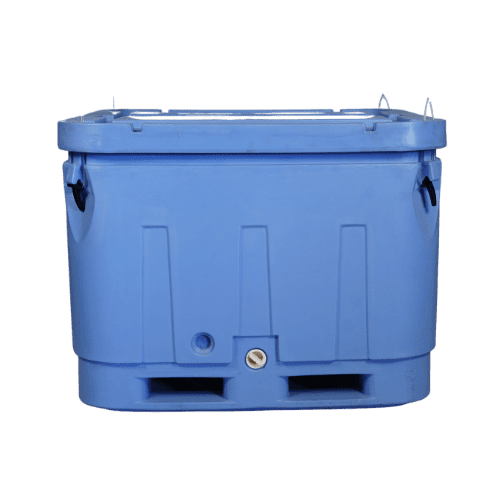
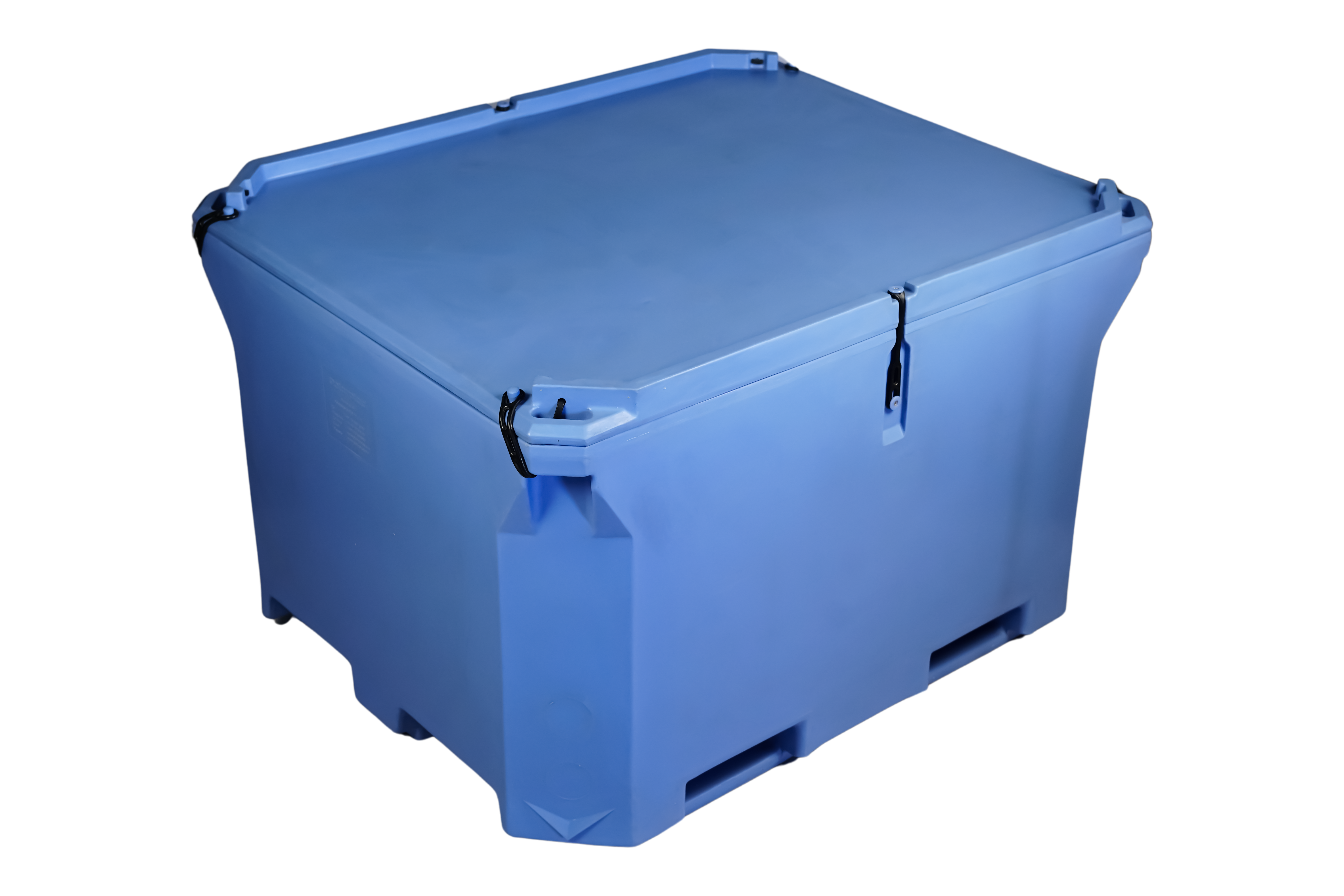
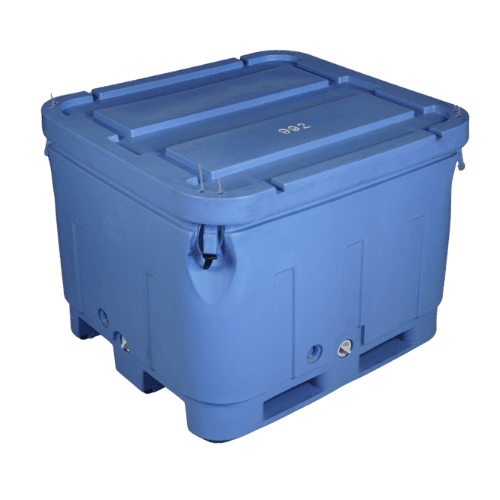
In a PUR bin, rigid polyurethane foam is injected into the cavity and bonds to the polyethylene walls. In a PE foam bin, the core is polyethylene foam, so the whole wall is one plastic family. Polarplas manufactures both, with UV-resistant material, stackable bodies, rubber-strap lids and optional drains. You can browse each range here: PUR foamed tubs and bins and PE foamed tubs and bins.
PUR vs PE Foam Insulated Bins: Side-by-Side Comparison
Use this table as a fast filter. The figures are general industry behaviour; real results depend on wall thickness, lid fit, ambient heat and how well the bin is iced.
| Factor | PUR Foam Insulated Bins | PE Foam Insulated Bins |
|---|---|---|
| Foam core | Injected polyurethane | Polyethylene foam |
| Thermal retention | Highest; holds cold longest | Good; shorter holding time |
| Weight | Lighter for the same size | Heavier, more robust feel |
| Abuse tolerance | Strong, protect the outer skin | Very strong, forgiving on rough docks |
| Best for | Export, long hauls, hot climates | On-board, processing, daily rough use |
| Upfront price | Higher | Lower |
| Running cost | Less ice, less spoilage risk | More ice on long holds |
Thermal Retention: Which Keeps Product Colder Longer?
This is where PUR vs PE foam insulated bins separate most clearly. Polyurethane is a closed-cell rigid foam with very low thermal conductivity. A European fisheries reference reports that PUR-insulated containers can insulate roughly three times better than PE-foamed ones, while also being 25 to 30 percent lighter (Eurofish). Treat that as a guide, not a guarantee, but the direction is consistent across the industry.
What does that mean on a US dock? Ice melts more slowly, so you top up less often and you lose less product to temperature drift. The FAO notes that insulated boxes cut the ice needed to chill and hold fish, and the main drawback is higher purchase cost (FAO insulated fish boxes guide).
Where Thermal Retention Matters Most
- Summer dock work in Houston, New Orleans, Tampa and Miami, where ambient heat is relentless.
- Long trucking lanes, such as Seattle to the Midwest or Boston to Chicago.
- Export consolidation, where totes wait on a pier before loading.
- High-value species like tuna, wild salmon, scallops and live-chilled shrimp.
PE foam bins still perform well when ice is packed correctly and turnaround is short. For same-day deliveries inside a city, the extra insulation of PUR may simply not be needed.
Durability: Which Bin Survives Real-World Abuse?
Durability is the strength of PE foam insulated bins. The foam is the same plastic family as the shell, so the wall behaves like one tough structure. Forklift bumps, stacking, hosing down and ice shovelling are all part of daily life, and PE foam bins shrug off a lot of it.
PUR bins are also seamless and strong, but the best results come from respecting the shell. Deep gouges can let moisture reach the foam over time, which reduces insulation. Good handling, regular inspection and prompt repair of damaged bins keep PUR performance high for years.
Both types gain from UV-stabilised polyethylene, which matters on sunny docks in California, Florida and the Gulf Coast. Smooth, seamless interiors also make cleaning faster, which is essential for seafood hygiene programmes.
Weight and Handling: The Hidden Labour Cost
Every pound saved on an empty tote helps your crew. A lighter PUR bin is easier to tilt, drain and slide onto a pallet jack, and it reduces strain across a long shift. If workers move bins manually between a boat, a cooler and a truck, weight is a real productivity factor.
A heavier PE foam bin is not a weakness in every setting. On a fixed processing line where forklifts do the lifting, its sturdy feel can be an advantage. The right answer depends on who is moving the bin, and how often.
Cost: Upfront Price vs Total Cost of Ownership
PE foam insulated bins usually cost less to buy. PUR bins cost more up front because of the foam system and the process. The smart comparison is total cost, not sticker price. Run these four numbers for your own operation:
- Ice spend: pounds of ice per trip multiplied by trips per month.
- Spoilage loss: value of product downgraded or rejected because it warmed up.
- Labour and freight: handling time and the weight you ship per load.
- Service life: how many seasons the bin stays in service.
For long holds and hot lanes, PUR often wins on total cost. For short, high-turnover work, PE foam often wins. A mixed fleet is a common and practical answer.
Which One Should You Buy? Match the Bin to the Job
Pick PUR Foam Insulated Bins If:
- You ship seafood over long distances or export from US ports.
- You work in hot, humid regions.
- You want less ice and lighter totes.
- Product value is high and temperature risk is costly.
Pick PE Foam Insulated Bins If:
- Your bins take rough handling every day.
- Trips are short and ice is cheap and nearby.
- You need a lower purchase price per bin.
- You use bins on boats, docks and processing lines.
Food Safety Checklist for US Buyers
Whichever foam you choose, the inner surface touches food, so confirm the basics before you order. US seafood programmes lean on HACCP principles and food-contact rules from the FDA, and sourcing guidance from NOAA Fisheries. Ask every supplier, including us, for:
- Food-grade polyethylene resin documentation for the inner liner.
- A smooth, seamless interior with a drain option for melt water.
- UV-stabilised material for outdoor use.
- Lid design that seals well, with a rubber strap for transport.
- Traceability options such as in-mould serial numbers, barcode, QR code or RFID.
Polarplas offers in-mould embossing, engraving, screen printing and tracking options on its rotomoulded range, which helps US buyers who need to identify bins by lot, owner or route.
Where US Buyers Use Insulated Fish Bins
Polarplas Serves Seafood and Cold Chain Buyers Across the United States
From Pacific fisheries to Atlantic ports and the Gulf, insulated bins protect fish, shrimp, crab and meat. We support buyers in:
- Seattle, WA
- Kodiak and Anchorage, AK
- Portland, ME
- Gloucester, MA
- New Bedford, MA
- Boston, MA
- New York and New Jersey
- Baltimore, MD
- Norfolk, VA
- Charleston, SC
- Miami and Tampa, FL
- New Orleans, LA
- Houston, TX
- San Diego and Los Angeles, CA
Planning for another region? See our guides on hygienic plastic pallets in the USA, insulated fish bins for tuna and shrimp in Indonesia and PE foamed fish tubs for the UK.
Polarplas PUR and PE Foam Range
Polarplas has manufactured rotomoulded and injection moulded products for export markets since 1996. Our insulated bins range from compact sizes up to 1400 litres, in LLDPE or HDPE, with double-wall PUR or PE foam insulation. Two good starting points for US buyers:
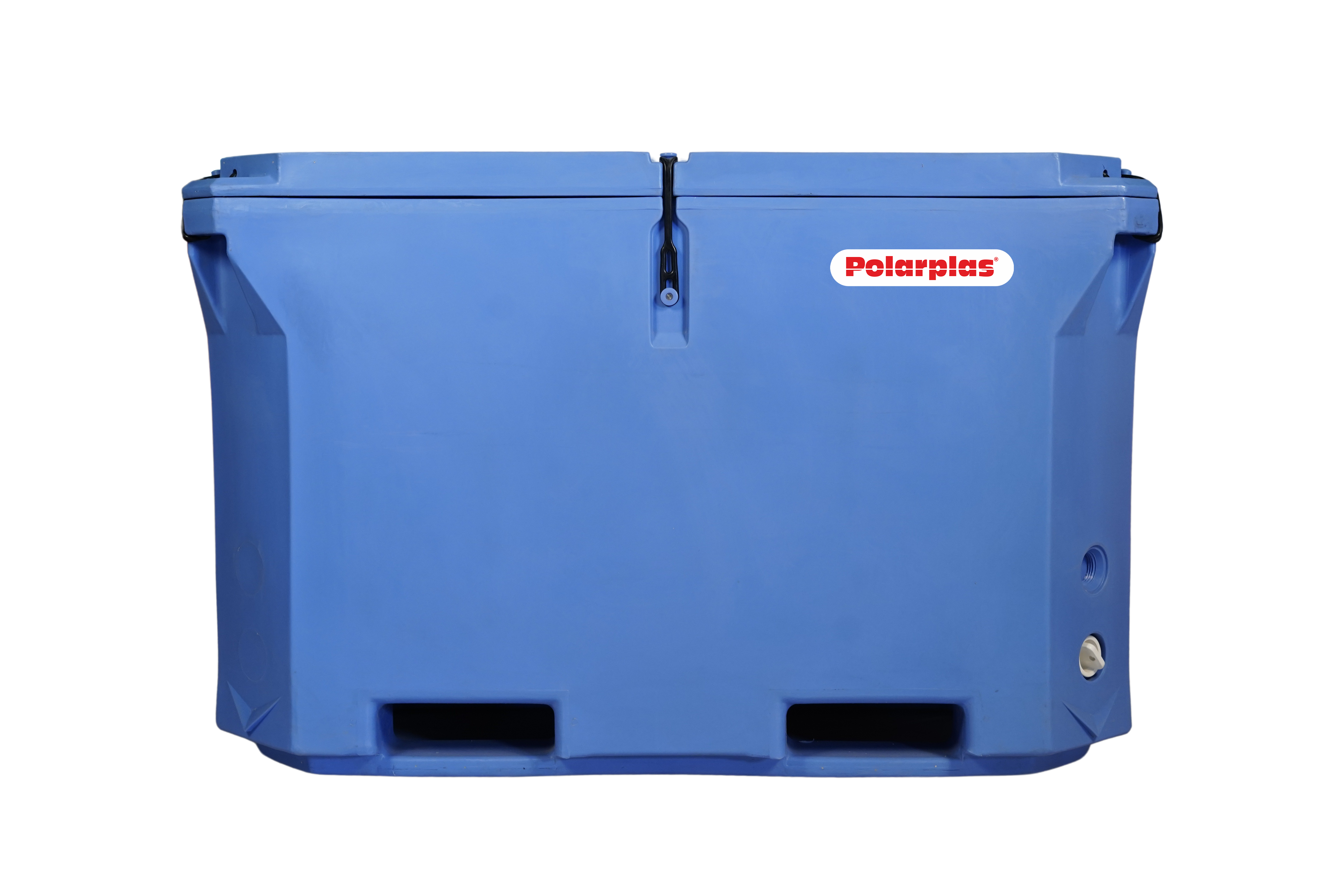
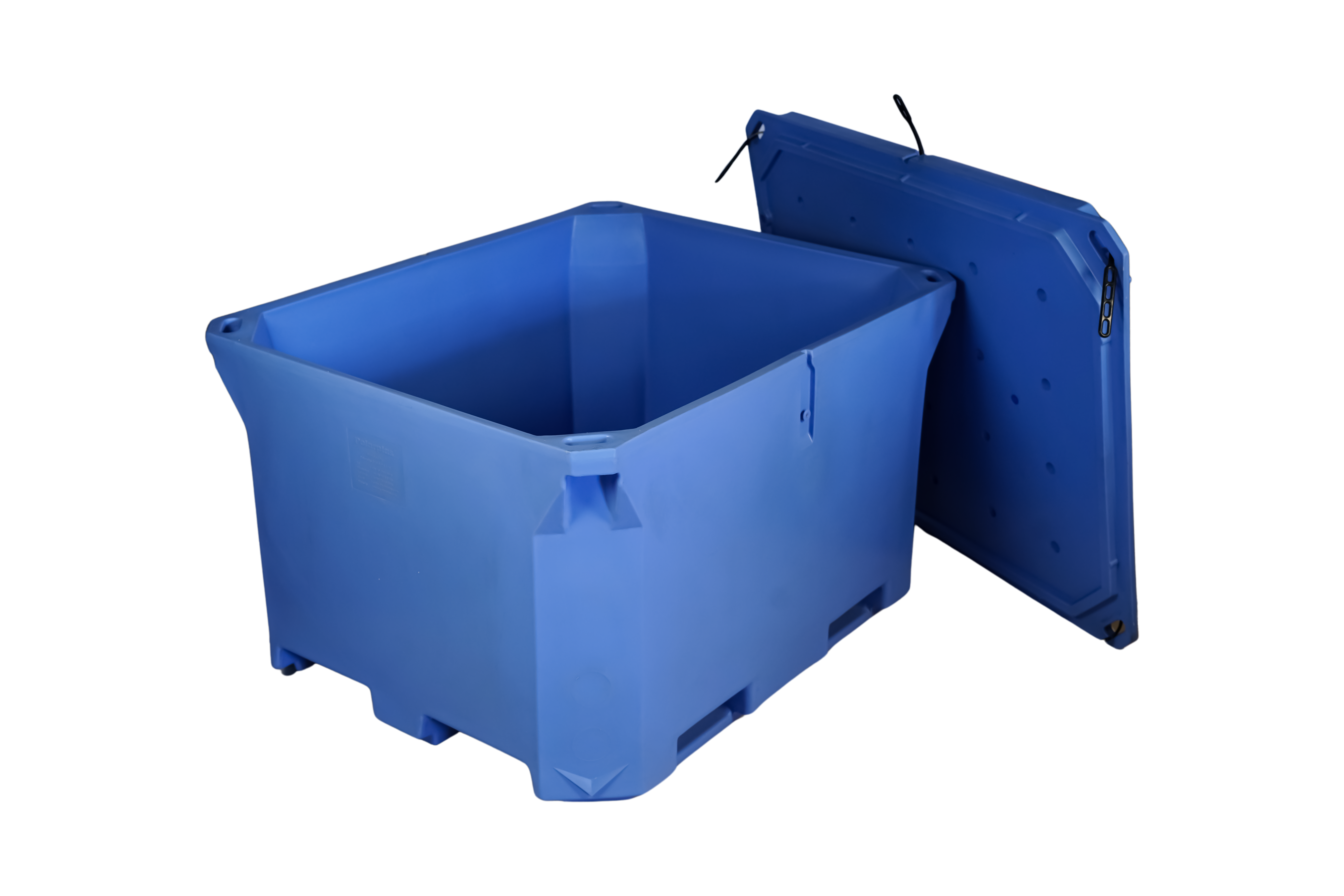
- PUR option: the PP-DX327P1U PUR insulated container, 48 x 42 x 32 in external and 266 gallons gross volume, built for heavy-duty seafood cold chain use. For bigger loads, see the 1000 L PUR insulated container.
- PE foam option: the 1000 L PE foam insulated fish tub (PP-D1000P1E), 58 x 46 x 38 in external and 264 gallons, with drain facility options and stackable design.
Need ice boxes, buggies or pallets alongside your bins? Explore our insulated coolers and ice boxes, hygienic pallets or custom moulded products, or see the full product catalogue.
How to Choose Between PUR and PE Foam in 5 Steps
- Measure your hold time. Over 24 to 48 hours of holding, PUR gains a clear edge.
- Check your climate. Gulf, Florida and Southern California summers favour PUR.
- Look at your handling. Manual lifting favours PUR; forklift-driven, rough use favours PE foam.
- Calculate total cost. Include ice, spoilage, labour and freight, not only bin price.
- Test a mixed pilot. Order a few of each, track ice use and temperature for one season, then scale the winner.
Frequently Asked Questions: PUR vs PE Foam Insulated Bins
Which is better: PUR or PE foam insulated bins?
Neither wins everywhere. PUR foam insulated bins give the best thermal retention and the lowest weight, so they suit export, long hauls and hot climates. PE foam bins give excellent toughness at a lower price, so they suit rough daily use and short trips.
How long does ice last in PUR vs PE foam bins?
It depends on wall thickness, lid fit, ambient temperature and the ice-to-product ratio. PUR bins generally hold ice longer than PE foam bins of the same size. European references report iced fish keeping for about eight to ten days in insulated tubs in cool climates; expect shorter periods in a hot US summer.
Are PUR insulated bins more expensive than PE foam bins?
Yes, PUR bins usually cost more to buy. They can still lower total cost through reduced ice use, lower product loss and lighter handling, especially on long or hot supply routes.
Can PE foam bins be used for shrimp, tuna or crab?
Yes. PE foam insulated bins work well for shrimp, tuna, crab and other seafood when ice is packed correctly and transit time is moderate. For long export lanes or very hot conditions, PUR is the safer choice.
Are these insulated bins food safe for US seafood use?
Polarplas bins use food-grade polyethylene surfaces with smooth, seamless interiors. As with any supplier, request resin and food-contact documentation that matches your own HACCP and customer requirements before you buy.
Does Polarplas supply insulated fish bins to the United States?
Polarplas designs its products for export markets and supports buyers in the USA, including Seattle, Boston, Miami, New Orleans, Houston and Los Angeles. Contact our team for sizes, logo marking options, shipping terms and a quotation.
Can I get custom logos, colours or tracking on my bins?
Yes. Polarplas offers in-mould embossing, engraving, screen printing, post-moulded labels, serial numbering, barcode and QR options, and RFID tracking on its rotomoulded range. Colour options are shown on each product page.
Get the Right Insulated Bins for Your US Operation
Tell us your species, hold time, route and volume. We will recommend PUR, PE foam or a mix, with a quotation for your port or warehouse.
Request a Quote
sales@polarplas.com
Call +91 79 4007 3880 | Polarplas India Private Limited, Ahmedabad, Gujarat, India
Sources: Eurofish: storage, transportation, maturation and collection; FAO: Insulated Fish Boxes. Product data from polarplas.com.
